Yes, a public speaking app can help with interview prep by giving you feedback on filler words, pace, and clarity as you rehearse answers aloud. It supports delivery practice, not the research, relevant examples, or technical knowledge your interview requires. For your interview preparation, use it alongside role-specific questions and a mock conversation rather than as your only preparation method.
- Can a public speaking app help with interview prep? Yes: use delivery feedback alongside role-specific preparation.
- Orai can support interview candidates who want instant feedback on filler words, pace, and clarity.
- Practice real interview answers, not unrelated speeches; check both what you say and how you say it.
- Keep a mock conversation in your preparation so you also practice follow-up questions and listening.
Can a public speaking app help with job interview prep?
Yes. The useful connection is direct: interviews require spoken answers, and a public speaking app gives you a way to rehearse those answers and examine your delivery. The practice should sound like an interview, not a presentation you happen to know well.
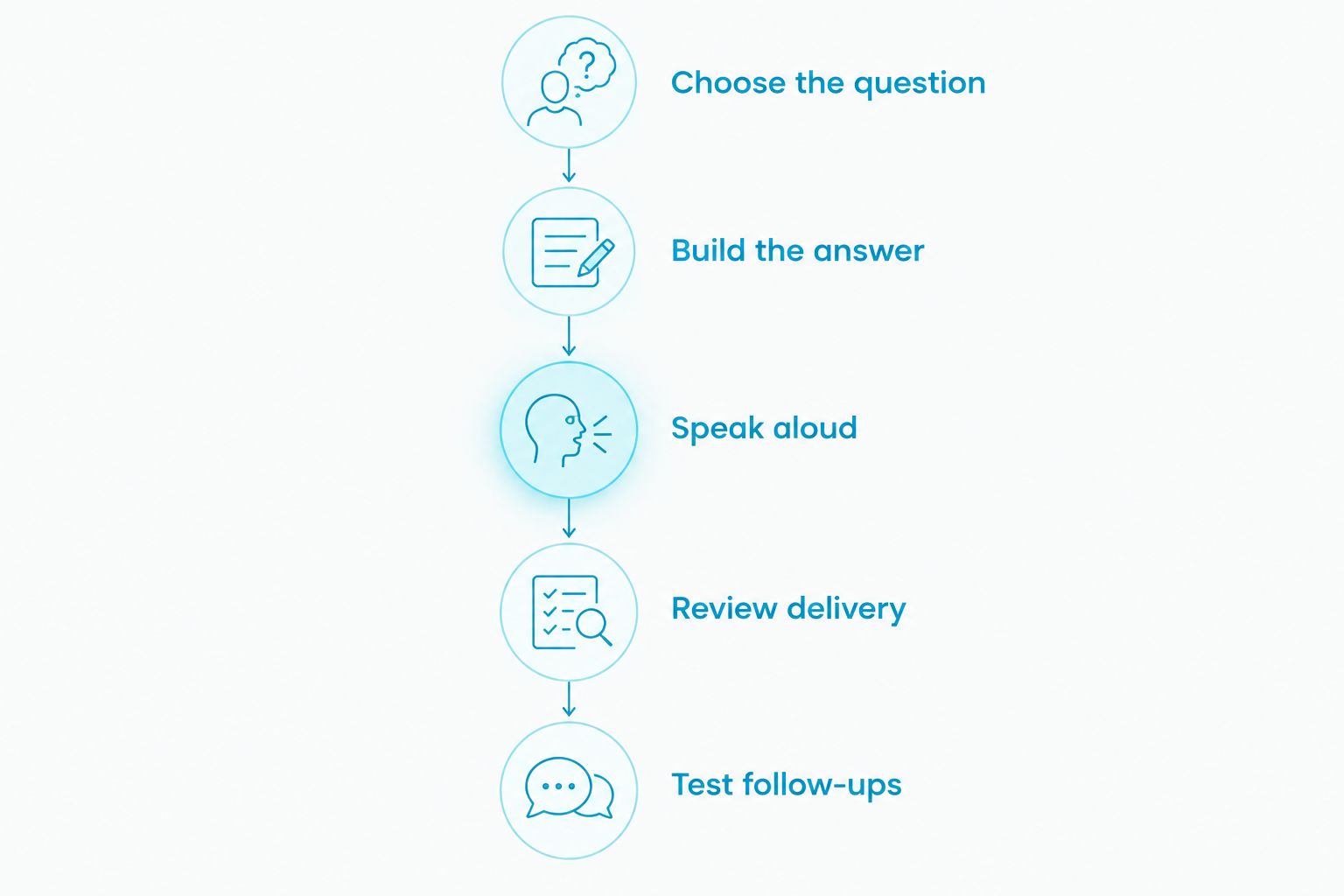
Use this sequence to connect delivery feedback to the questions you expect to face.
Choose the question
Pick a question tied to the role, such as why you want the position, how you handled a difficult project, or how you would approach a relevant problem. Write down what the question is asking before drafting an answer.
For example, a question about handling disagreement needs an example of disagreement and your response. A general account of a successful project does not address it unless that account includes the conflict. Match the example to the question before polishing the delivery.
Build the answer
Make brief notes covering your main point, the context the listener needs, your own actions, and the outcome. Use facts you can explain accurately if the interviewer asks for more detail.
Keep the distinction between team results and your contribution clear. You can acknowledge shared work without leaving the interviewer guessing about what you did. If you do not have a measured outcome, explain the result honestly rather than adding a number to sound impressive.
Speak aloud
Answer the question without reading a finished paragraph word for word. Notes can keep you on track, but your practice needs to reveal how you explain the example when you have to form sentences aloud.
Finish the attempt before correcting every stumble. Otherwise, you are practicing your opening repeatedly instead of learning how the full answer holds together. Listen for where you lose the thread, rush through useful evidence, or continue after making your point.
Review delivery
Check the feedback on filler words, pace, and clarity. Choose a specific issue to address in the next attempt rather than trying to change your entire speaking style at once.
Keep a separate content check: did you answer the question, explain your contribution, and give a relevant outcome? Delivery feedback and content review serve different purposes. A smoother answer is not automatically a stronger example.
Test follow-ups
Ask a practice partner to interrupt with a reasonable follow-up, request clarification, or question an assumption. This changes the exercise from rehearsing a prepared answer to taking part in a conversation.
If you practice alone, change the wording of the question and answer again without restarting your prepared introduction. Check whether you can explain the same experience from a different angle. Your practice plan should prepare you to respond, not just recite.
Which interview preparation method fits your task?
A public speaking app, solo rehearsal, and a mock interview each give you a different practice format. Choose according to the question you need answered about your preparation, not because one method sounds more advanced.
| Practice method | Best for | Useful part | Limitation |
|---|---|---|---|
| Public speaking app | Reviewing delivery | Gives feedback on speaking features such as filler words, pace, and clarity | Delivery feedback alone does not establish whether your example fits the role |
| Solo rehearsal | Organizing your examples | Lets you work through questions and revise your wording independently | You must supply your own critique and follow-up questions |
| Mock interview with a partner | Practicing conversation | Lets a partner interrupt, ask follow-ups, and request clarification | The exercise depends on the questions and feedback your partner provides |
Use the methods together when you need both delivery practice and conversational practice. You do not need to repeat the same exercise in every format. Work on the explanation alone, review its delivery, then test whether it survives a follow-up question.
Tell your practice partner what to evaluate. Ask whether your example answered the question, whether your contribution was clear, and what needed clarification. A broad instruction to judge your confidence gives them less direction than a specific request about the answer.
Why the usefulness of interview practice varies
The value of delivery feedback depends on what you bring to the practice session and what you do with the feedback. Use these factors to choose your next exercise:
- Question relevance: Practice prompts tied to the job. A polished answer to an unrelated question does not prepare the example you need.
- Filler words: Review where fillers appear, then rehearse that part of the answer. Do not make removing every filler your only goal.
- Pace: Check whether you rush through the actions and results that explain your contribution. Practice those passages deliberately.
- Clarity: Make the main point explicit and remove context the interviewer does not need to understand it.
- Answer accuracy: Keep claims grounded in your actual experience. Delivery practice does not justify stronger claims than your evidence supports.
- Follow-up practice: Include clarification questions so your preparation is not limited to uninterrupted answers.
These checks keep the feedback connected to the interview. If the problem is an irrelevant example, choose a better example. If the problem is unclear delivery, rehearse the explanation. Do not solve a content problem by polishing the wrong answer.
How do I practice “Tell me about yourself” with an app?
Practice a role-relevant introduction, then use delivery feedback to check how clearly you explain it. Start with your current professional focus, connect relevant experience to the position, and explain why the opportunity interests you.
Leave out details that do not help the interviewer understand that connection. You are not required to turn your entire career into an opening answer. Choose the background that gives the conversation a useful starting point.
After rehearsing, ask whether someone unfamiliar with your work could explain why you are applying. If the connection is unclear, revise the content before another delivery attempt. Once the message is right, focus on the speaking issue you want to improve.
Can delivery feedback make a weak interview answer stronger?
Delivery feedback can help you present an answer more clearly, but it cannot replace missing evidence. If the question asks how you resolved a problem, the answer still needs the problem, your actions, and an honest account of the result.
Separate vague wording from unclear speaking. Saying you worked hard or communicated well does not show what you did. Replace those summaries with concrete actions you can discuss, then rehearse the revised answer aloud.
The same rule applies to an answer that is too long. Before trying to speak faster, remove material that does not help answer the question. Edit the answer before accelerating the delivery.
Is a public speaking app enough for interview prep ?
A public speaking app is not enough on its own when your interview requires role knowledge, relevant examples, or technical answers. Use it for delivery practice while preparing those requirements separately.
Read the job description and connect its responsibilities to your experience. Prepare questions about the role that you genuinely want answered. For interviews involving exercises or specialist knowledge, practice that work directly rather than treating speaking practice as a replacement.
Keep listening in the preparation, too. During a mock conversation, let the partner finish the question and check what they asked before responding. If the question differs from your rehearsed prompt, adapt the answer rather than forcing the original version into the conversation.
Example: turn a vague interview answer into evidence
Question: Tell me about a time you handled disagreement.
Weak starting answer: “We had a difficult project, but I communicated well and we finished it.” The delivery could be smooth, yet the interviewer still does not know what the disagreement was or what you did.
A more useful outline: “Two teammates disagreed about which launch issues to prioritize. I asked each to explain the customer impact, put the issues into a shared list, and helped the team agree on what had to be fixed before launch.” Add the real outcome from your experience; do not borrow or invent the facts in this example.
Record your own answer. Check whether you explain the disagreement, your action, and the result before evaluating pace or fillers. Repeat once with one delivery correction, then ask a partner, “What would you have done if the team still disagreed?”
Try our interview-answer practice tool and read how to organize your thoughts when speaking. For presenting a prepared task during an interview, see our interview presentation guide.
FAQ
Can a public speaking app help with interview prep if I use lots of filler words?
Yes, a public speaking app can help you review filler words while rehearsing interview answers. Use the feedback to choose a passage to practice again, while keeping relevance and clarity as your main goals.
Is Orai useful for practicing job interview answers?
Orai is useful for interview delivery practice because it provides instant feedback on filler words, pace, and clarity through a mobile and web app. Review your answer's accuracy and relevance separately.
Should I use an app instead of doing a mock interview?
Use an app for delivery feedback and a mock interview for conversational practice. A partner can ask follow-up questions and request clarification, giving you a different exercise from rehearsing alone.
Can a speaking app tell me whether my answer is right for the job?
Delivery feedback alone does not establish whether an answer is right for the job. Compare your example with the question and role requirements, and check that it explains your contribution accurately.
Should I memorize my interview answers word for word?
Practice from brief notes rather than making word-for-word recall your main goal. Keep the example's facts consistent while practicing different question wording and follow-ups.
Can Orai help me practice for a video interview?
Orai can support spoken-answer practice with feedback on filler words, pace, and clarity. Check your camera framing, sound, and interview setup separately; delivery feedback does not replace those checks.
What should I focus on during interview preparation ?
Focus on relevant examples, accurate answers, clear delivery, and responding to follow-up questions . Use speaking feedback for delivery and role-specific preparation for the substance of your answers.