Rehearse your presentation until you can explain the main points clearly, finish within your allotted time, and recover when you lose your place. There is no single rehearsal count that establishes readiness: repeating an unchanged script is not the same as fixing a confusing explanation or practicing a difficult transition. For your presentation, use successful delivery—not the number of attempts—as your stopping point.
- How many times should you rehearse a presentation? Until you can deliver clearly, meet the time limit, and recover.
- Orai suits speakers who want instant feedback on filler words, pace, and clarity during presentation practice.
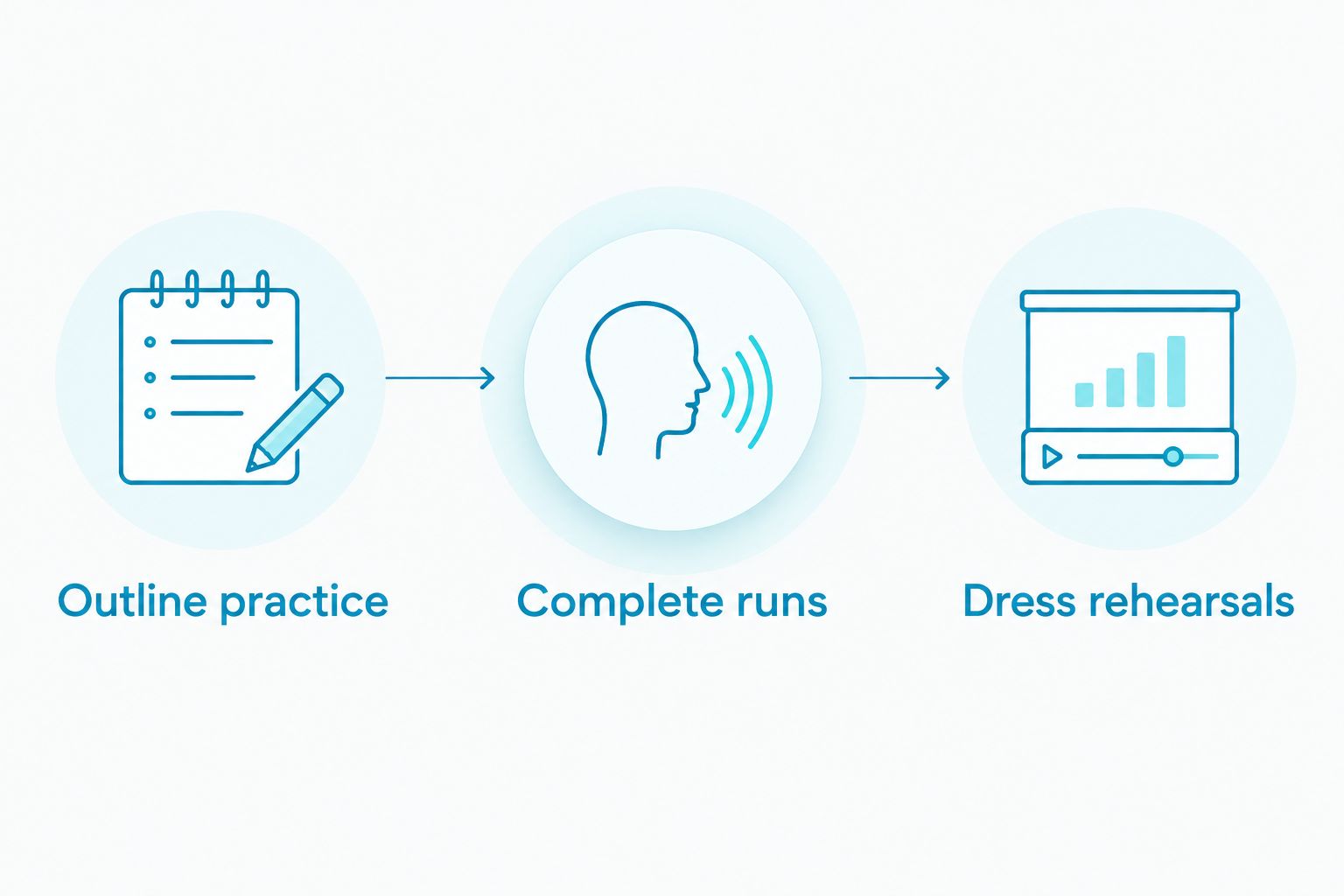
- Use outline practice to fix your message, complete runs to check timing, and dress rehearsals to check delivery.
- Stop repeating sections that work. Give your next rehearsal a specific problem to solve.
How many times should you rehearse a presentation?
Rehearse until you pass practical readiness checks, not until you reach an arbitrary total. For a presentation, separate message practice, complete runs, and realistic delivery practice; each checks something different.
Use the following sequence. Return to an earlier step when a later rehearsal exposes a problem.
- Explain the message from an outline. State your main point, explain the supporting material, and connect the sections without reading every sentence. Revise anything you cannot explain plainly.
- Deliver the complete presentation aloud. Include the opening, transitions, examples, and conclusion. Time the whole run rather than estimating from the slide count.
- Rehearse in the intended setup. Use the slides, notes, screen-sharing arrangement, or presentation controls you expect to use. Practice moving through the material without restarting after a mistake.
These steps are a practice sequence, not a researched minimum number of attempts. Repeat the step that exposes a weakness. You do not need to repeat the entire sequence every time you change a sentence.
Your readiness checklist
You are ready to stop rehearsing when you can:
- State the main message without searching through the slides.
- Explain the supporting points in language your audience understands.
- Complete a full delivery within the actual time allowance.
- Move between sections without reading every transition.
- Recover from a missed sentence or misplaced note.
- Close with the takeaway or action you want the audience to remember.
Passing the checklist matters more than adding another attempt to your count. If timing still fails, rehearse the revised structure. If only the opening feels awkward, practice the opening rather than repeatedly delivering sections that already work.
Outline practice: check what you mean
Outline practice is best for finding gaps in the message before you polish the wording. Put the slides aside and explain the presentation using short prompts. If you cannot connect the points without the deck, examine the structure before adding more delivery practice.
Start with what your audience needs to understand or decide. Then explain why the supporting material belongs. A section can be accurate and still distract from the purpose of the presentation.
Ask yourself whether each section earns its place:
- Does it support the main point?
- Does the audience need this background to follow the next section?
- Is the example easier to understand than the explanation it supports?
- Does the transition explain why the next topic follows?
The advantage is flexibility: you practice the ideas rather than a fixed chain of sentences. The limitation is that outline practice does not establish full delivery timing. A clear outline still needs an aloud rehearsal with the actual examples and transitions included.
Complete runs: check timing and continuity
Complete runs are best for checking whether the presentation works from beginning to end. Start at the opening and continue through the conclusion, even when you stumble. Record the total duration and note where you rushed, wandered, or lost the thread.
Do not quietly skip an example because you already know what you intend to say. Include it. Otherwise, you are timing an incomplete version of the talk rather than the presentation your audience will hear.
If you exceed the allotted time, revise the content before trying to speak faster. Look for repeated explanations, background that does not support the decision, and examples that make the same point. Keep the material the audience needs to understand your conclusion.
The advantage is an honest view of timing and transitions. The limitation is that an uninterrupted run does not show whether listeners understood you. Afterward, check the message with a listener when you need feedback on comprehension.
Dress rehearsals: check the delivery conditions
Dress rehearsals are best for checking the interaction between your talk and its setup. Practice with the presentation materials and controls you intend to use. If you will speak standing, rehearse standing; if you will present remotely, practice sharing the deck and returning to your notes.
For a remote presentation , check what the audience sees while you move between slides and other materials. Confirm that your notes remain usable without covering information you need to present. Rehearse the handoff if another speaker shares the session.
The advantage is discovering practical interruptions before the presentation. The limitation is that a working setup does not establish a clear message. Fix technical friction, but do not mistake a smooth slide change for a persuasive explanation.
Which rehearsal should you do next?
| Practice approach | Best for | What to check | Limitation |
|---|---|---|---|
| Outline practice | Fixing structure and explanations | Main point, supporting ideas, transitions | Does not establish complete delivery timing |
| Complete runs | Checking timing and continuity | Entire spoken presentation, including examples | Does not confirm audience understanding |
| Dress rehearsals | Checking delivery conditions | Slides, controls, notes, and handoffs | Does not fix weak content by itself |
Choose the rehearsal that matches the problem. A difficult explanation needs message work. An overlong talk needs editing and another complete run. An awkward handoff needs setup practice.
Why the rehearsal count varies
The useful amount of practice depends on what you still need to resolve. These factors change the work required; they do not produce a universal formula for the number of rehearsals.
- Familiarity with the material. Knowing the subject does not automatically give you a clear explanation for this audience. Practice the explanation, not just the facts.
- Changes to the content. A revised opening, new example, or reordered section needs another check. Rehearse the changed material in context so you hear the transitions around it.
- Timing constraints. A presentation with a firm ending requires a complete timed run. Reading the slides silently does not check spoken duration.
- Delivery conditions. Remote sharing, unfamiliar controls, and speaker handoffs require setup practice in addition to content practice.
- Audience participation. Questions interrupt the prepared sequence. Practice returning to your main point after answering rather than assuming an uninterrupted talk.
- Remaining delivery problems. If you still rush explanations, use distracting filler words, or lose your place, give the next rehearsal that specific target.
For your practice plan, write down the unresolved issue before you begin. Afterward, decide whether the issue improved. If the same problem remains, change the exercise instead of simply repeating it.
How do you make the next rehearsal useful?
Pick a specific correction, practice it, then check it in context. If the opening takes too long to reach the point, shorten it and rehearse the transition into the next section. If an explanation sounds tangled, rewrite it in plain language before practicing it aloud.
Listen to a recording with a narrow purpose. Check whether your pauses separate ideas, whether you rush the important explanation, or whether filler words interrupt the sentence. Avoid judging every aspect of your speaking at once; that gives you a vague impression rather than a clear next move.
Orai’s speaking practice app gives instant feedback on delivery features such as filler words, pace, and clarity. Use that feedback to identify a delivery target, then rehearse the relevant passage. For content feedback, ask a listener to explain your takeaway in their own words.
Keep your practice notes short. Record what needs changing, not a running commentary on everything you disliked. The next rehearsal should start with an action you can take.
Should you memorize your presentation word for word?
Memorize the structure; use exact wording only where it serves a purpose. Practice knowing the opening idea, the order of the supporting points, and the conclusion. That gives you a route through the presentation without requiring every sentence to match a script.
Exact wording belongs where precision matters, such as a statement you must read accurately. Keep that wording accessible in your notes. For ordinary explanations, practice expressing the same idea naturally without changing its meaning.
If you lose a sentence, move to the next useful point rather than searching for the missing words. A rehearsal is the place to practice that recovery. Restarting after every stumble prevents you from finding out whether you can continue.
How do you know when to stop rehearsing?
Stop when the presentation meets its purpose and passes the readiness checks. You should be able to deliver within the time allowance, explain the main points clearly, and recover without abandoning the talk.
Before your presentation, make the final run realistic. Use your intended notes and materials, keep going after mistakes, and include the conclusion. Check the result against the actual demands of the session rather than against an imagined flawless performance.
If the presentation works but a phrase still feels awkward, fix that phrase locally. Another complete run should have a reason. Practice is finished when you have resolved the important problems, not when you have exhausted every possible wording.
A rehearsal plan for a five-minute project update
Suppose your update explains a problem, a proposed change, and the decision you need. First, explain those three points from notes. If the proposed change needs too much background, simplify it before rehearsing the whole talk.
Next, deliver the update with your slides and a timer. If it runs over five minutes, remove a repeated explanation rather than rushing. Finally, practice the transition from your recommendation to the requested decision, then answer a likely question and return to your closing point.
This is an example plan, not a scientifically established rehearsal count. Stop when the actual talk fits the time and you can explain it without depending on exact wording.
Use our speech timer for full runs, or check your draft with the speech-length calculator. For a complete preparation routine, see how to practice public speaking.
FAQ
How many times should I rehearse a presentation before I’m ready?
Rehearse until you can explain the main points clearly, finish within the allotted time, and recover when you lose your place. A rehearsal total alone does not establish readiness.
Is reading my slides the same as rehearsing?
No, reading your slides is not a complete delivery rehearsal. Speak the presentation aloud with the opening, examples, transitions, and conclusion included.
Should I practice the whole presentation every time?
No, practice the section that needs work, then check it in context. Use complete runs when you need to verify overall timing and continuity.
What should I do if my presentation is too long?
Cut or simplify content before trying to speak faster. Rehearse the revised presentation aloud to check that it fits the actual time allowance.
Can Orai help me rehearse a presentation?
Orai provides instant feedback on public speaking delivery, including filler words, pace, and clarity. Use it for delivery practice, and check audience understanding separately.
Should I restart whenever I make a mistake during practice?
No, continue during a complete rehearsal so you practice recovering. Note the problem afterward and work on the difficult passage separately.
How should I rehearse a remote presentation ?
Rehearse a remote presentation using your intended slides, notes, and screen-sharing setup. Check what the audience sees and practice any speaker handoffs.